
48-Hour Luxor Itinerary: Pharaohs, Birthday Cakes and a Promise Kept
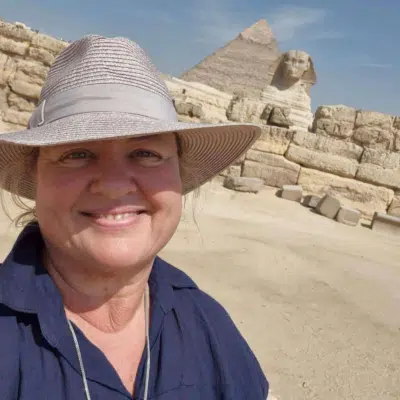
There are worse ways to start your 54th birthday than arriving in Luxor, Egypt, at one o’clock in the morning.
Although getting there was becoming a bit of a bloody mission.
Our flights through Cairo had been delayed, and after hours of hanging around an airport, the unexpected upgrade to business class was a very welcome birthday present. The lounge was even better. Somewhere comfortable to sit, something to eat, and a chance to escape the airport chaos while we waited.
By the time we finally landed in Luxor, I was exhausted. But Egypt still had surprises in store.
We arrived at the Sonesta St. George Hotel, right on the Nile, in the middle of the night. Outside, everything was dark. Inside, the enormous chandelier hanging in reception was absolutely magnificent.
You know those moments when you’re so tired you can barely string a sentence together, but something makes you stop and stare? That chandelier did it.
The hotel had also discovered it was my birthday and arranged a cake. Which was lovely. Except that it arrived at my room about half an hour after check-in, somewhere around two o’clock in the morning.
I’d only just had a shower and changed into my pyjamas, had spent hours travelling and was now being presented with a birthday cake when all I wanted was a pillow. Naturally, I took photographs.
It was such a thoughtful gesture, and I appreciated it enormously, even if my stomach wasn’t particularly interested in celebrating at that hour. What I didn’t know was that this was only the first of the birthday cakes Luxor had planned for me.
And while I’d come to see the temples and sail the Nile, another reason for this journey mattered so much to me. I’d made a promise to a friend. And it was time to keep it.
48 Hours in Luxor at a Glance
Don’t miss: Luxor Temple at sunset, the Avenue of Sphinxes, Karnak Temple, a sunrise hot-air balloon flight, Hatshepsut’s Temple and the Valley of the Kings
Best advice
Book a knowledgeable Egyptologist and reliable transport. There’s far too much history here to spend your time trying to work out what you’re looking at.
Worth knowing
Luxor is extraordinary, but trying to squeeze it into 48 hours is absolutely exhausting.
Day 1: A Promise to Keep and Pharaohs at Sunset
Breakfast Beside the Nile

I woke on my 54th birthday beside one of the world’s most famous rivers. “The Nile.” Even saying those words felt extraordinary. But before the sightseeing, before the temples, and before boarding our cruise ship, I needed to do something.
My friend Jill had told me that she wanted to cruise denial for her 50th birthday, but she never made it. Breast cancer took her far too early, and I’d carried the sadness of that unfinished dream with me for years. Jill had been my friend, travel mentor and travel agent, with a wicked sense of humour and a laugh you didn’t forget in a hurry.
When she became too ill to travel, I’d created an imaginary journey around the world for her, sending little surprises from different countries. One of those gifts was a silver necklace that she never received, and it became mine to carry. I called it ‘Tink,’ and it’s travelled with me ever since.
I’d promised myself that one day I would cruise denial and take her with me. That morning, I walked down to the river’s edge with my necklace. I dipped Tink into the water and stood there for a moment. I felt Jilly’s loss deeply. I still missed her, and standing beside the river she’d wanted so badly to experience brought that grief right to the surface.

But there was something else. Pride! I’d kept my promise, and with that came a feeling I hadn’t expected. A weight lifted from my heart; I could actually feel the lightness settle into my chest.
Four years after the birthday Jill had dreamed of, I was standing beside the Nile on my own 54th birthday. In my own little way, I’d brought her with me. It was a quiet moment, and one I’ll carry for the rest of my life.
Then, because travel doesn’t stop for sentiment, it was time to pack our bags and get on a boat, juggling the cake! I couldn’t leave it behind now, could I?
Boarding the Princess Sarah II
We were joining the Princess Sarah II for our Nile cruise. Now, if you’ve never seen the cruise boats moored along the river in Luxor, there’s something you should know.
They don’t necessarily line up neatly, each with its own convenient little gangway. They moor side by side. Which means you can find yourself walking through several other cruise ships just to reach yours.
It’s a strange introduction to river cruising, wandering through one boat, then another, wondering if you’ve somehow boarded the wrong vessel before finally arriving at the one you’re supposed to be on.
The jetty is an experience in itself.
The local children selling souvenirs have it all worked out. They’re very good at getting directly in your path, making sure you can’t take another step without at least acknowledging whatever they’re selling. That morning it was mostly bookmarks, although you’ll find all sorts of things being offered around the tourist areas.
It can be unsettling if you’re not used to it, especially when you’re juggling bags, masses of people are moving in every direction, and several enthusiastic young salespeople have decided you’re their next customer.
My advice?
Learn a few words of the local language, including how to say no thank you, La shukran (lah SHOOK-ran). Smile, be kind, make yourself understood, and keep walking. You don’t need to be rude, and you don’t need to buy something simply because someone has managed to block your path.
Once we were finally on board, I discovered the crew had another surprise waiting.
Birthday cake. Again. And flowers.
Honestly, I was beginning to wonder how many cakes one woman could accumulate in 24 hours. The first one had been tussled to the boat and was too big for the refrigerator in my cabin. But it was another beautiful gesture, and the crew made me feel incredibly welcome.

The Princess Sarah II would be our home as we travelled along the Nile, and I was already falling in love with the whole experience.
Luxor Temple at Sunset

That evening we visited Luxor Temple, and I don’t think I was prepared for how beautiful it would be. I’d seen photographs of Egypt’s temples, of course. Everyone has. But photographs don’t prepare you for the sheer scale of these places. The columns. The statues. The carvings. The enormous pieces of stone that have stood here for thousands of years.
And then there’s the light.
We arrived as the sun was dropping, turning the sky a beautiful rosy orange. That warm colour against the ancient stone was spectacular. As the evening lighting came on, the whole place changed again. The carvings became more dramatic, the columns seemed even taller and the temple took on this wonderfully romantic atmosphere.
- How on earth did they build these places?
- How many people had walked through here before me?
- What had these walls witnessed?
Luxor Temple is connected to Karnak Temple by the Avenue of Sphinxes, an extraordinary ceremonial route stretching for roughly three kilometres. Imagine that. A processional avenue lined with sphinxes, connecting two enormous temple complexes. And here I was, standing in the middle of it all on my birthday.
I’d met Tony and Denese, a lovely Australian couple, during the journey, and sharing these experiences with people who were just as fascinated by Egypt made the trip even more enjoyable.
But standing there in the evening light, I couldn’t help thinking how romantic it would be to experience Luxor Temple with someone you love. The soft colours of the sunset, the illuminated stone, the history surrounding you. It would be a beautiful place to share a moment together.
Even without the romance, just me and Tink, I was completely blown away. And that was only our first evening.
Day 2: Balloons, Pharaohs and the Valley of the Kings
Sunrise Over Luxor
The next morning started ridiculously early. But when you’re going on a hot-air balloon flight over Luxor, complaining about getting out of bed seems a bit unnecessary. Besides, after arriving in Egypt in the middle of the night, I’d already accepted that sleep wouldn’t be a major feature of this particular birthday adventure.

Waiting for the winds to be just right, then the torches blasting to fill the balloons as they rose off the ground in the early morning sunrise, was exciting enough. Then we were up there ourselves, floating on the breeze.
The view was something else. What struck me most wasn’t simply the temples or the river. It was the extraordinary contrast between the green farmland around the Nile and the abrupt line that the Sahara Desert created.
From above, you could see the fertile pastures stretching out beside the water, lush and green, and then this distinct edge where the cultivated land ended and the desert began.
One moment, life and greenery. The next, vast stretches of dry, sandy country. It was almost unbelievable. I’d known the Nile was the lifeblood of Egypt, but seeing that contrast from the air made it real in a way no textbook could ever explain.
The river has sustained civilisation here for thousands of years, and suddenly you could see why. The green and the desert sat side by side, so different that it hardly seemed possible they belonged to the same landscape.
I had to remind myself to stop taking photos and videos and just enjoy the moment. I was trying to consume it and preserve it at the same time.
Some travel experiences are lovely at the time and gradually fade from your memory. This view will not be one of them.
Hatshepsut’s Temple: A Woman Who Ruled as Pharaoh

Back on the ground, we headed to the Mortuary Temple of Hatshepsut.
Hat, cheap suit is how I was taught to say it. Now, here’s a woman whose story deserves attention. Hatshepsut (see, you can say it now) was one of ancient Egypt’s most remarkable rulers, a female pharaoh who held power in a world we often associate with kings.
And she certainly didn’t do things by halves. Her temple sits against the towering limestone cliffs at Deir el-Bahari, (nope, can’t help you there) with enormous terraces and columns rising out of the desert landscape.
The setting is spectacular. The architecture seems to belong to the mountain behind it, and the sheer size of the place makes you feel rather insignificant. I found myself doing something repeatedly throughout Egypt.
I’d catch my breath. Then I’d take another deep breath, almost deliberately breathing in the ancient air around me. I know that sounds a bit dramatic, but that’s what Egypt does to me.
Standing in places where people lived, worshipped, ruled, fought, and died thousands of years ago, and somehow that history feels close enough to touch, I wanted to absorb every bit of it.
Hatshepsut’s story made the experience even more fascinating, a woman who pretended to be a man, ruled as pharaoh, who commissioned extraordinary monuments and whose legacy is still drawing people from around the world. I reckon she’d have some stories to tell.
The Valley of the Kings

Next came the Valley of the Kings. And if you think the temples above ground are impressive, wait until you go underground.
The Valley of the Kings is where many of Egypt’s New Kingdom pharaohs were buried, their tombs cut deep into the desert hills. From the outside, the landscape is stark. Rocky Mountains. Dry earth. Very little to suggest the astonishing decoration hidden beneath your feet. Then you enter a tomb.
And everything changes.
We visited the tombs of Ramses II and Ramses IV, and they were among the most spectacular ancient sites I saw during my time in Egypt. The preserved colours were incredible.
The detailed carvings, painted ceilings, and walls covered with scenes and hieroglyphics were almost too much to take in. As an Aussie living in a country with 125 years of modern history, I had to keep reminding myself that this country was 5000 years old; these weren’t modern reproductions created to impress tourists.
People had stood here thousands of years before me, creating these extraordinary works for rulers they believed would continue into the afterlife. The amount of work involved is staggering.
And the fact that so much of the colour and detail has survived is almost impossible to comprehend. I could have spent 48 hours looking at the walls, finding something new every time I turned around.
This is where having a good Egyptologist makes an enormous difference.
Without someone explaining the stories, symbols, and beliefs behind what you’re seeing, you can easily walk past something extraordinary without understanding its significance. With the right guide, those painted walls begin to tell you their stories.
And suddenly the names of pharaohs you’ve heard since school become real people. People with ambitions, egos, families, enemies and very elaborate plans for what happened after they died.
Quite elaborate.
Karnak Temple: Saving One of the Biggest for Last

We also visited Karnak Temple, the magnificent complex connected to Luxor Temple by the Avenue of Sphinxes. If Luxor Temple had taken my breath away at sunset, Karnak was determined to finish the job. The scale is difficult to explain.
Enormous columns rise above you, covered in carvings, while courtyards, statues and monumental gateways seem to stretch on forever. You walk into one space thinking you’ve seen something extraordinary, only to turn a corner and find something even more impressive. I spent much of my time looking up. And wondering.
- How did they move those stones?
- How did they carve them?
- How did they manage to build something so enormous without the machinery we rely on today?
It’s one thing to read about ancient Egyptian civilisation. It’s quite another to stand among the remains of it. At Karnak, the history feels almost overwhelming. I kept taking those deep breaths again. Breathing in Egypt and trying to hold onto the feeling. Because that’s what I love most about this country.
Egypt is a place you feel, not just visit. The history oozes into every pore.
Anissa Renae Kunda
Why a Good Guide Matters in Luxor
If you’re planning 48 hours in Luxor, one of the best things you can do is organise a knowledgeable guide and reliable transport. I travelled with On The Go Tours, and I found the experience excellent.
Having someone take care of the arrangements meant we could concentrate on enjoying the places we’d come so far to see. But even more important was having an experienced, passionate Egyptologist explaining the history.
Luxor is packed with extraordinary sites, and there’s an enormous difference between standing in front of an ancient carving wondering what it means and having someone explain the story behind it. The temples are impressive enough on their own. Understanding them takes the experience to another level.
And when you’re moving between sites in the heat, dealing with crowds and trying to fit an extraordinary amount into a short visit, having transport organised is a blessing, but transport with cold water and chilled face cloths is even better.
My advice is to spend your money on a good guide rather than trying to do everything yourself. You’ll get far more out of the experience.
Where to Stay and How to Experience Luxor
Sonesta St. George Hotel
I stayed at the Sonesta St. George Hotel, right on the Nile. My arrival was in the middle of the night, so I didn’t get the full impact of the river until morning. But that spectacular chandelier in reception made quite an impression.
The hotel’s thoughtful birthday surprise also deserves a mention, even if cake at two o’clock in the morning wasn’t exactly what my exhausted body had in mind.
Being beside the Nile made my stay particularly special, given the promise I’d come to fulfil.
Cruising on the Princess Sarah II
We boarded the Princess Sarah II to begin our Nile cruise. There’s something wonderful about the idea of travelling through Egypt along the same river that has sustained its civilisation for thousands of years.
Despite the slightly chaotic business of getting through several moored cruise ships to reach ours, being welcomed aboard with flowers and yet another birthday cake was lovely.
A Nile cruise is a beautiful way to continue exploring beyond Luxor, particularly if you want to see more of Egypt without constantly packing and unpacking.

Are 48 Hours in Luxor Enough?
Absolutely not.
But if that’s all the time you have, take it.
In two days, I celebrated my 54th birthday, kept a promise to a friend, boarded a Nile cruise, stood inside some of the most magnificent temples I’ve ever seen, floated above the green fields and Sahara Desert at sunrise, and walked through the tombs of ancient pharaohs.
I met wonderful people, ate more birthday cake than any woman needs to admit and spent a ridiculous amount of time standing with my mouth open. And somewhere in the middle of all that, I found a little peace.
I’d arrived in Luxor carrying a promise to Jill. I’d held onto it for years. Standing at the edge of the Nile with Tink in my hand, I finally did what I’d said I would do.
That moment didn’t take away the sadness of losing my friend. Nothing does. But it lifted something from my heart, and I left knowing I’d honoured a dream she never had the chance to fulfil.
When it came time to sail away from Luxor, I was genuinely sad. I could have stayed for a week. There were more temples to explore, more stories to hear and so much history I hadn’t even begun to understand.
And I have to admit, I love saying the word Luxor.
Luxor.
Even the name sounds wonderful. Forty-eight hours here was exhausting, emotional, spectacular and, at times, completely overwhelming.
But would I do it again? In a heartbeat.
Preferably with a little more sleep. And perhaps slightly less birthday cake.
- About the Author
- More info
Renae Kunda is the co-owner of Cape York Motorcycle Adventures, a pioneering eco-certified dirt bike tour company in Far Northern Queensland, Australia. Passionate about adventure and deeply connected to the region’s rugged landscapes, Renae plays a vital role in delivering authentic, sustainable experiences for riders from around the globe. With a commitment to preserving the natural beauty of the Cape, she ensures every adventure leaves a lasting connection to the land and its stories.