
48-Hour Baku Itinerary: Mud Volcanoes, Cave Dwellers and a Mountain of Fire

I booked my trip to “the Caucasus” thinking mostly about great snow-capped mountains and remote villages in Georgia up close to the Russian border, but first on the agenda apparently was Azerbaijan, a country I confess I knew nothing about.
So I did my homework, discovering that Azerbaijan today is an independent wealthy oil-rich nation that for hundreds of years was under control of Iran, or the Persians, the Turks, the Imperial Russian Empire and lastly the Soviets.
And my 48 hours in the capital, Baku (population 2.5 million) proved a revelation: mud volcanoes, petroglyphs of cave-dwellers, a mountain of fire, an ancient walled city, and a thriving revival of traditional customs and culture suppressed under communist rule.
48-Hour Baku Itinerary at a Glance
Here’s the complete 48-hour Baku itinerary at a glance, split between the city and the strange landscapes outside it.
Day one stays in Baku, from the martyrs’ memorial on the hill down through the walled Old City. Day two heads out to the Gobustan mud volcanoes and petroglyphs, then to the burning gas vents of the Absheron Peninsula.
Day 1: The City
- Morning: Martyrs’ Lane and the panoramic terraces above the city
- Midday: The walled Old City, Shirvanshah’s Palace and the Maiden Tower
- Afternoon: The Heydar Aliyev Cultural Center
- Late afternoon: The Carpet Museum, off the seaside boulevard
- Evening: Dolma and black tea at a family-run restaurant, with live tar
Day 2: Mud, Rock and Fire
- Morning: The Gobustan mud volcanoes, an hour southwest by 4WD
- Midday: Gobustan’s petroglyphs, chipped into rock 5,000 to 8,000 years ago
- Lunch: Back in Baku, at Fountains Square
- Afternoon: Yanardag, where natural gas vents have burned for millennia
- Late afternoon: Ateshgah, the Zoroastrian fire temple whose flame went out
Day one: Martyrs’ Lane and the view over the Caspian
My exploration of Baku began high on the hill that rises steeply behind the city to a memorial known as Martyrs’ Lane, dedicated to mostly unarmed civilians who faced up to the Soviet Army in 1990, in a period known as Black January, just prior to the collapse of the USSR.
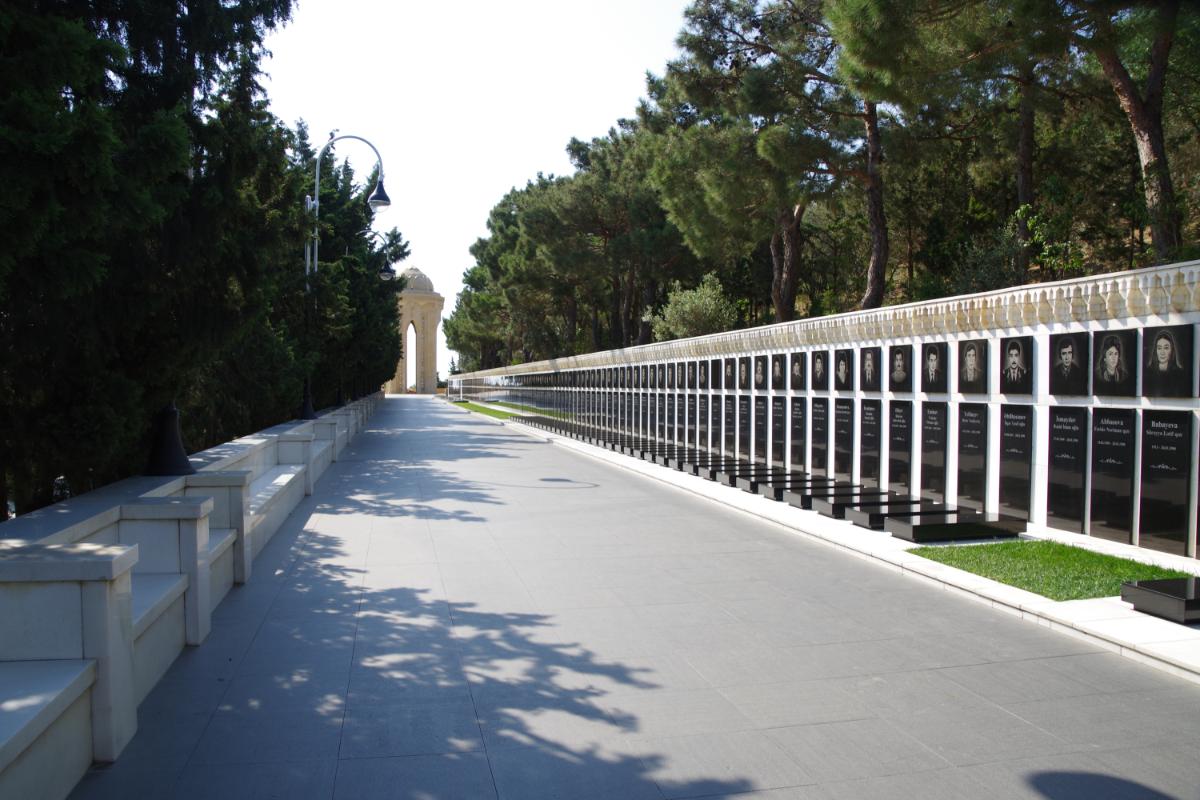
Their black marble tombs, headstones etched with photographic portraits, all bearing the date of death as January 20, are set in gleaming white marble walls flanking the “lane” that leads to a tower containing an eternal flame.

Beyond the tower, a terraced area called Uplands Park opens up panoramic views over the city, with some of the fine modern architecturally outstanding buildings reflected in the waters of the Caspian Sea.

Inside the walled Old City
I could also distinguish the outline of my next stop, the UNESCO Heritage Old City enclosed by 12th-century defensive walls. The sprawling 15th-century Shirvanshah’s Palace, itself a fortress within its own walls, is the centerpiece.

Elsewhere within the Old City, I explored Silk Road caravanserais, hammams (traditional bath houses), carpet shops, art studios, gallerias, restaurants and I found it impossible to ignore the temptations of the little hole-in-the-wall confectionary shops.
The lower end of the City is dominated by the Maiden Tower, a commanding 30-meter-high cylindrical structure. There’s plenty of speculation about its purposes, but a watchtower was certainly one of them.
I climb to the top for an overview of the alleys and narrow cobbled streets below.

Back in the day, however, I’d have been looking the other way, out over the salty plains bordering the Caspian Sea for the approach of potential invaders.
Or traders arriving from the east along the fabled Silk Road.
The Heydar Aliyev Cultural Center
Moving rapidly into the 21st century, my next call, the Heydar Aliyev Cultural Center, is an architectural landmark in Baku, sitting atop a hill, surrounded by manicured lawns.

Modern art abounds in the gleaming white courtyards of the wave-like structure, and within are some eight floors of exhibition halls and auditoriums, housing both permanent and temporary exhibitions, ranging from dolls to classic cars.

Like many others around me, I am fascinated by a feature just inside the entrance, where a flow of hot air causes sheets of silk in the colors of the national flag to dance and intertwine in ways that are never the same.

A museum shaped like a roll of carpet
As I join the locals for one of their favorite pastimes, a stroll along the seaside boulevard, I don’t have any issues about finding the Carpet Museum.
That would be the building whose roof looks like a roll of carpet, wouldn’t it? The main collection, obviously, is a range of carpets featuring various techniques, designs, and use of colors dating back to the early 17th century.
Many tell stories which staff can interpret for you. But it’s not all carpets.
I find a section dedicated to “Ceramics, glass, wood and paper”, another on embroidery, then traditional costumes, ranging from skull caps to shoes, curtains and tablecloths … and even a “moustache grooming case.”
Dolma, black tea and a tar player
The evening finds me with a group of other tourists in a family-run restaurant serving traditional dishes, such as dolma, where grape, mulberry, or cabbage leaves are stuffed with vegetables or fruits, a dish classified by UNESCO as an “intangible cultural heritage.”
Black tea, served in thistle-shaped glasses, and accompanied by fruit preserves complete the meal, while in the background a lively old man plays the long-necked stringed instrument called a tar.
It’s been a big first day, but tomorrow promises even more. The mud volcanoes beckon.
Day two: the mud volcanoes of Gobustan
It was an hour-long journey southwest to Gobustan next morning … 60 kilometers of highway followed by a rough road through flats zigzagged by rusting pipelines, train tracks, nomadic sheep herds, and along a clay track that couldn’t really be classified as a road.
We elected for four-wheel drive vehicles, unwilling to trust our lives to local Soviet-era taxis that appear to be falling apart and driven by maniacs with no concept of safety.
On a wind-swept plateau, a gray moonscape is scattered by conical mounds, two to three meters high. Mud is bubbling and oozing from deep in the bowels of the earth, making strange gurgling sounds.

But there are no spurts of hissing steam, no fierce boiling heat, no stinking sulfur smell that I’ve encountered in the volcanic areas of Japan or New Zealand.
This gray mud, forced from the depths of the earth by gas associated with oil fields, oozes from vents, not always at the “peak” of the volcano, at “room temperature”, dribbles down the sides and quickly begins to set like drying cement.
This surface cracks up, forms a dust and then re-sets solidly, but with a hollow ring. Like other visitors, I scramble all over this landscape to take pictures, for the area is uncontrolled.

A couple of locals, whom I discover are medical practitioners, arrive with large ladles to scoop mud into plastic containers to use for a range of therapeutic and cosmetic purposes.

Cave dwellers and 8,000-year-old petroglyphs
Next stop, some 15 minutes from the volcanoes, is what is understatedly described as “an open-air archaeological museum”, but we are talking about observing the life and times of cave-dwelling Neolithic man, clearly depicted in petroglyphs chipped into rock between 5,000 to 8,000 years ago.
Images, some remarkably clear, are of hunting, flora, fauna and life-style. My eye is caught by one that looks remarkably like a Viking longboat, and not surprisingly the subject of much speculation.

A rough but clearly designated track takes me from one set of petroglyphs to the next, set in a landscape of caves and boulders the size of a house tossed around by ancient earthquakes.

Although you could wander around on your own, I’d certainly recommend using a guide.
Yanardag, the mountain of fire
I return to Baku, grab a meal in Fountains Square (yes there are plenty of fountains), a pedestrianized area much loved by locals full of boutiques and restaurants.
Refreshed, I head out of Baku through oil fields populated by nodding green and red classic oil pumps, to the so-called “flaming mountain” of Yanardag, on the Absheron Peninsula.
You won’t exactly see a mountainside ablaze, but there are several vents through which flaming natural gas has been burning non-stop for perhaps 5,000 years.

When I pose for a photograph beside them, I’m astonished at the fierceness of the heat. It was in this part of the world that the so-called “fire worshipping” Zoroastrian religion had its roots.

The fire temple whose flame went out
The nearby temple of Ateshgah was a pilgrimage site for centuries … until, late in the 19th century, the permanent flames on a tower in the middle of the complex spluttered and died.
The reason why undoubtedly lies in an old photograph on display within the temple.
In it, an oil derrick virtually overlooks the temple walls, one of a field that may contain the first commercial oil-well in the world (although somebody in Pennsylvania might dispute that!), which began production in the 1840s.
Oil drilling upset the flow of natural gas, and the fire in the temple was extinguished.
And, just as the Zoroastrians discovered it’s unwise to rely on a single source of inspiration, so is the Azerbaijan Government trying to wean itself from total reliance on oil, and is actively encouraging tourism as part of that.
And possibly wishing you’ll spend much more than my 48 hours. You certainly could.
More Universal Traveller Guides to Central Asia and the Caucasus
- Traveling Overland From Iran to the Caucasus
- Camping at the Gates of Hell in Turkmenistan
- Road Trip: The Pamir Highway in Central Asia
- A Trip on the Trans-Siberian Railway
- Best Things to Do in Istanbul
- About the Author
- More info
Alistair Smith is a former journalist and PR and small business owner, studied for a Diploma of Travel (International) then more than 30 year as specialist professional freelance travel writing visiting all seven continents, around 100 countries, published in all major Australian newspapers, plus specialist magazines in Australia and overseas. Author of “Been There, Done That … and have a story to prove it” (self denigrating anecdotes covering mishaps, humour, cultural encounters, industry insights).