Volcano Boarding in Nicaragua: My Run Down Cerro Negro

The board is a plank of wood with a metal sheet screwed to the bottom and a rope to hold on to. The slope is loose black gravel, and the volcano underneath it last erupted in 1999.
That was the setup for one of the strangest afternoons I have had in Central America: volcano boarding down Cerro Negro, near León in Nicaragua. It took an hour to climb and a couple of minutes to come down, and I crashed halfway.
Volcano boarding at a glance
- Where: Cerro Negro, about 40 minutes by truck from León, Nicaragua
- Tour price: Roughly US$25 to US$65 per person in 2026, depending on the operator and what is included
- Park entrance: US$10 per person, included by some operators
- The hike: About 45 minutes to an hour up loose volcanic rock, carrying your own board
- The run: A couple of minutes down a slope of around 41 degrees, sitting or standing
- Before you book: Nicaragua changed its entry rules in February 2026, and most visitors now need a visa approved in advance
A volcano younger than León’s cathedral
Cerro Negro is the youngest volcano in Central America. It first appeared in April 1850, rose to 728 meters, and has erupted around 23 times since.
Its eruptions are not just history. In 1992, the ash fall on León was heavy enough to collapse roofs across the city, and the last eruption came in 1999.
Volcano boarding here is younger still. Daryn Webb, who ran Bigfoot Hostel in León, turned it into a commercial tour around 2004 and 2005, and it is now a staple of every tour desk in the city.
There are two ways to ride. You can stand on the board like a snowboard, or sit on it like a sled, which is what almost everyone does.
Getting ready at the base
When we arrived at the foot of the volcano, our guide and the driver unloaded the boards and the protective gear from the roof of the van.

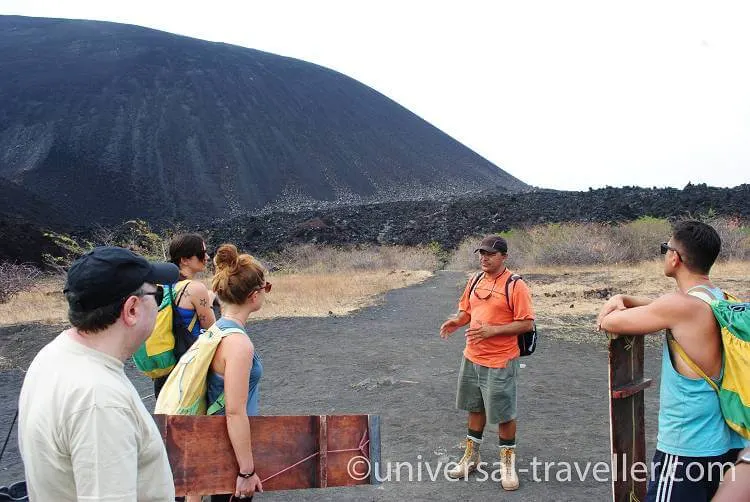
Before the climb, our guide gave us a short briefing on the volcano and its recent eruptions, then walked us through the plan for the afternoon. His last question was whether we were ready for the adrenaline rush.
We were. Let’s go.

The climb
The hike up the black cone takes about 45 minutes, carrying your board the whole way. Climbing first and riding second felt like a fair deal.


Once the hardest part was behind us, we stopped for a break to take in the landscape. Old lava flows run in black ridges across the green plain toward León, and the cone itself is streaked red, white and yellow where the minerals show through.


Twenty minutes later, we reached the crater rim of Cerro Negro.


The black run
Then it was time for the real thing. This is a black run in every sense of the word.

In person it looks even steeper than in the photos, and from the top you cannot see where the slope ends. The wind was blowing hard, and I will admit I had real respect for it.
Our guide gave us the last instructions and tips, took a group photo, and then we were ready to go.


My run, and my crash
I started slowly but built up speed fast once I reached the steepest part, at about 41 degrees. I tried to pose for the camera and lost control.


Volcanic gravel sprayed into my face and I came off the board. My jumpsuit was full of stones, and it took me a moment to get my bearings.


I was a little more than halfway down. I grabbed the board and set off again, this time with scratched glasses and no real idea how far the bottom was.
I picked up speed again, and so did the stones hitting my face.


Was it worth it?
The slope was steeper and longer than I expected, and I crashed once and ate plenty of volcanic grit. It was still a lot of fun, and I would do it again.
As a sport, it does not compare with snowboarding on real snow. As an experience, sliding down an active volcano is something you only get to do in a handful of places, and Cerro Negro is where the commercial version of the sport started.
Verdict: worth doing once. Go for the hike and the crater as much as the ride, because the run itself is over in a couple of minutes.
If I did it again, I would keep the goggles on instead of my own glasses, wear long sleeves under the jumpsuit, and keep my mouth closed on the way down. Leaning back slows you down, and leaning forward speeds you up.
Volcano boarding in León: what to know in 2026
Most tours leave León in the morning or for a sunset session, which avoids the worst of the midday heat on the black rock. Prices for 2026 run from about US$25 for a basic trip to US$65 for packages with food and transport included.
Bigfoot Hostel, the original operator, charges around US$37, and the US$10 park entrance fee is often extra. Some operators offer a porter to carry your board up for about US$5.
Tours include the board, a jumpsuit, goggles and gloves, plus a guide and the truck ride from León. Bring water, sunscreen, closed shoes and clothes you do not mind ruining.
Two things have changed since my visit. Since February 2026, Nicaragua has required most visitors, including US, Canadian and EU citizens, to obtain a visa approved in advance, so allow several weeks before you travel.
The US State Department also rates Nicaragua at Level 3, Reconsider Travel, as of May 2026, citing crime, health, wrongful detention and arbitrary enforcement of local laws. Check your own government’s advice before you book.
Volcano boarding tours from León are also listed on GetYourGuide.
Frequently asked questions
How much does volcano boarding in Nicaragua cost?
Volcano boarding tours on Cerro Negro near León cost roughly US$25 to US$65 per person in 2026, depending on the operator and whether food and transport are included. The Cerro Negro park entrance fee of US$10 per person is sometimes included and sometimes paid separately.
How long does it take to hike up Cerro Negro?
The hike from the base of Cerro Negro to the crater rim takes about 45 minutes to an hour on loose volcanic rock, and you carry your own board unless you pay a porter. The ride back down lasts only a couple of minutes, so most of a volcano boarding tour is the climb.
Is volcano boarding dangerous?
Falls are common on Cerro Negro, and the loose volcanic gravel causes scrapes and cuts, which is why tours provide jumpsuits, goggles and gloves. Riding seated, leaning back to control speed and keeping your mouth closed reduce the risk, and Cerro Negro has not erupted since 1999.
When is the best time to go volcano boarding in León?
The dry season, roughly December to April, gives the most reliable conditions for volcano boarding near León. Morning and sunset tours avoid the strongest midday heat, which can make the black volcanic rock very hot to climb.
More adventures in Latin America
If climbing volcanoes is your thing, read about hiking the Acatenango volcano in Guatemala or the best Arenal volcano hikes in Costa Rica.
For more of the region, see caving in Belize’s ATM Cave, sailing the San Blas Islands in Panama, and cycling Bolivia’s Death Road. Our list of the greatest adventures in the world covers the rest.
Have you tried volcano boarding, or is it something you would want to do? Tell me in the comments.
- About the Author
- More info
Tim Kroeger is the founder and editor of Universal Traveller, covering luxury stays and active travel. Based in Bangkok, he draws on 15+ years of travel across 112+ countries, from reviewing luxury hotels to bikepacking through Southeast Asia. He also writes about luxury wellness and longevity travel at tim-kroeger.com, where he developed the Restorative Index.